
 Available in GB
Content

The Number That Matters More Than RTP
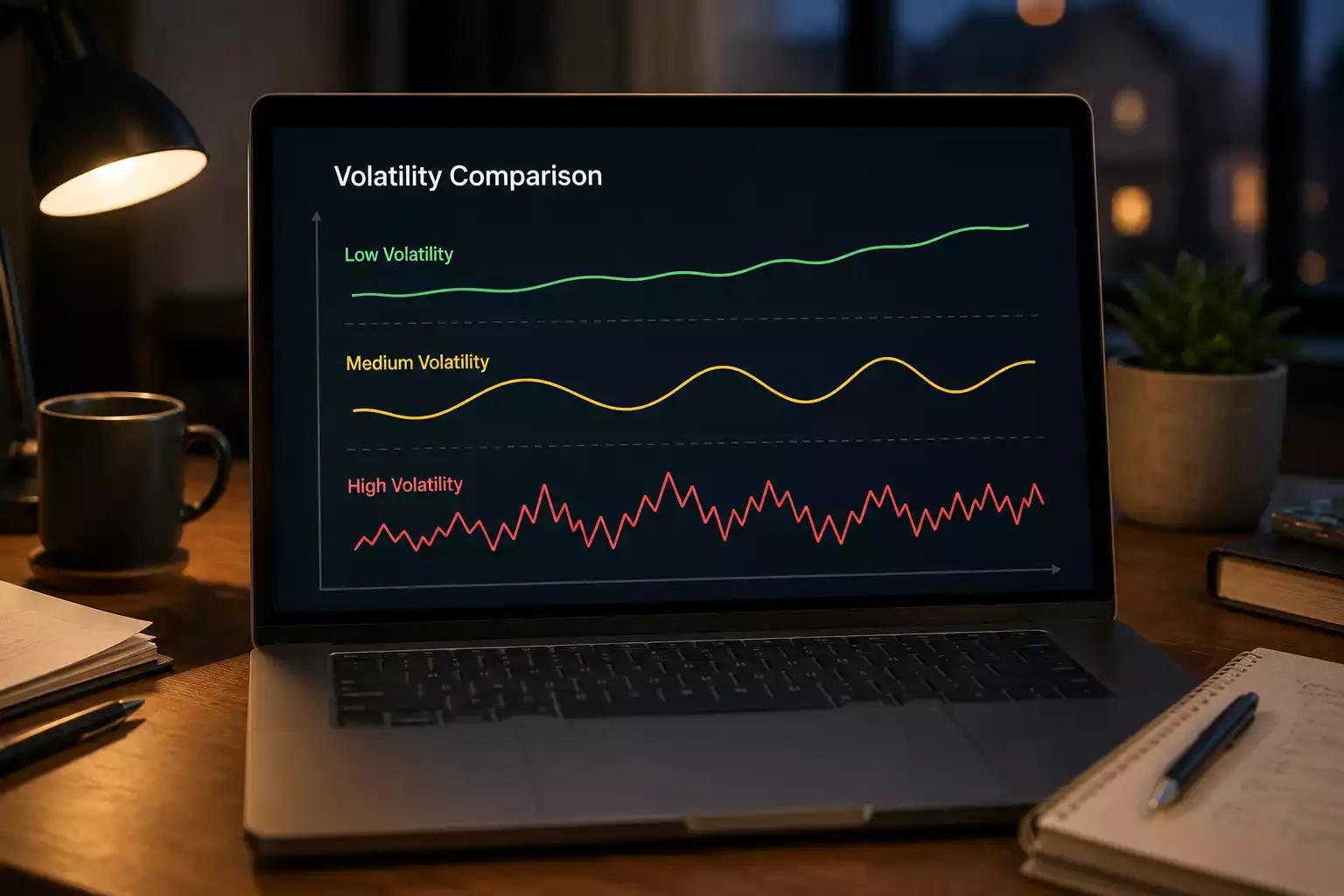
Ask most players what determines their slot experience and they will say RTP. Ask a game designer the same question and they will say volatility. Both are right, but they are answering different questions. RTP tells you where the maths converges over millions of spins — the theoretical long-run return. Volatility tells you what actually happens to your balance in the next hundred spins. And in practice, your session lasts hundreds of spins, not millions.
I have watched two slots with identical 96% RTPs produce radically different player experiences. One paid out small wins every five to eight spins, keeping the balance steady with gentle oscillations. The other went 40 spins without paying a penny, then delivered a 200x win that overshot the starting balance by a wide margin. Same RTP. Same long-run expectation. Completely different experiences. That difference is volatility, and it determines whether a game suits your bankroll, your temperament, and your session goals far more than the RTP percentage ever could.
The library it applies to: the slots selection.
Low, Medium, and High Variance in Real Terms
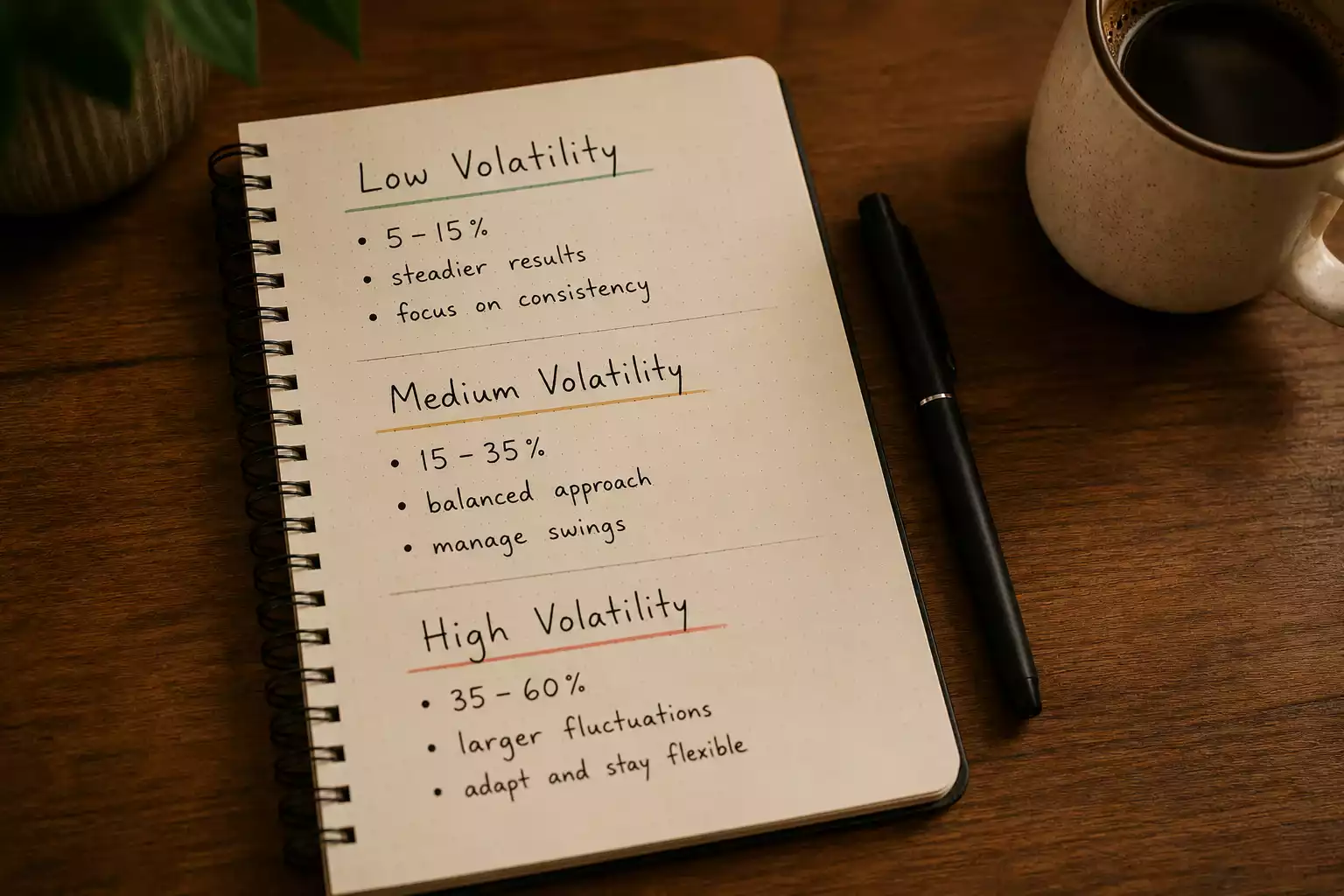
Game studios classify volatility on a spectrum, typically labelled low, medium, and high — though some use finer gradations or numerical scales. The labels describe the distribution of payouts, not their total. A low-volatility slot distributes its returns in frequent, small wins. You will hit winning combinations often, but individual payouts will rarely exceed 20x to 50x your stake. Your balance moves in a narrow band, and sessions tend to last longer for a given bankroll size.
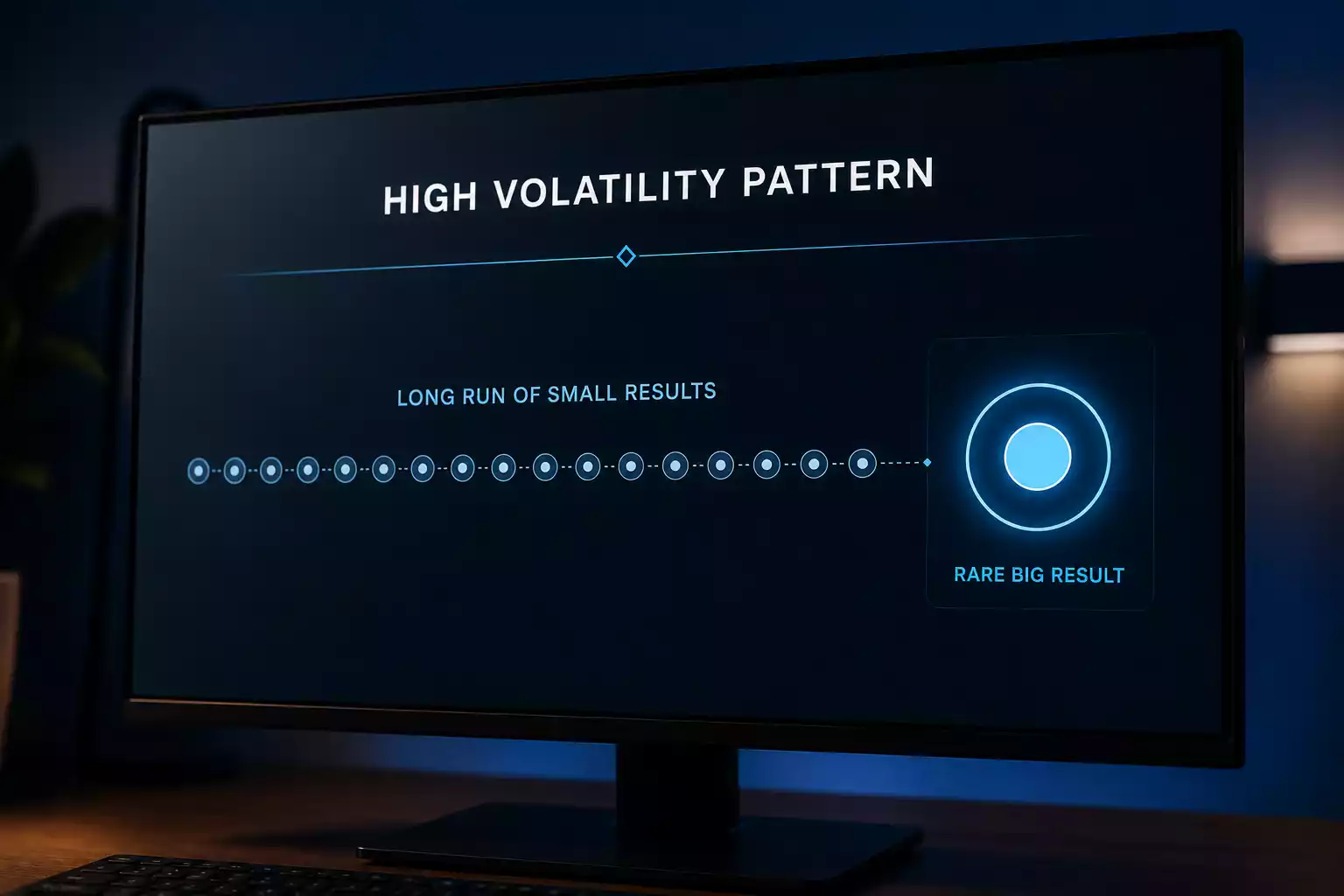
High-volatility slots concentrate their returns into rare, large payouts. You will experience long losing streaks interrupted by substantial wins — 500x, 1000x, or more in extreme cases. Your balance moves dramatically, and a session on a high-volatility slot can consume a starting bankroll in minutes or multiply it tenfold. The average online slot returns 96% to players over its lifetime, but a high-volatility slot might return 40% during one session and 180% during the next, with the 96% average emerging only across thousands of players and millions of spins.
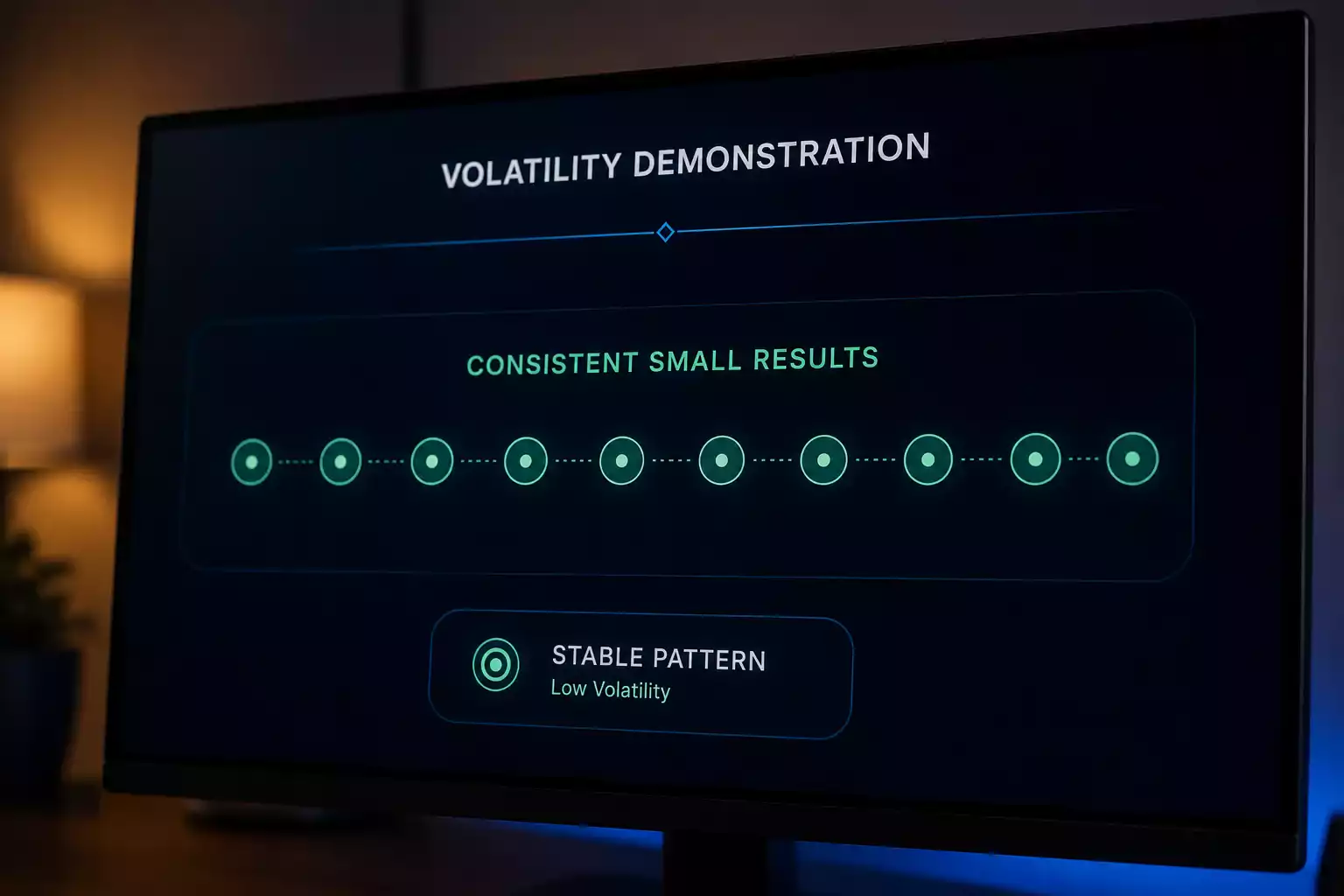
Medium volatility splits the difference, and most slots in any casino’s library — including Love Casino’s 12,000+ titles — fall into this middle category. Medium-variance games offer a mix of small frequent wins and occasional larger payouts, producing sessions that feel balanced but still carry meaningful swings in both directions.
How the £5 Stake Limit Changes Volatility Strategy
Here is where things get interesting for UK-facing markets. The £5 stake limit on online slots, introduced in April 2025 (with a £2 cap for players aged 18-24), fundamentally altered the relationship between volatility and player strategy at UKGC-licensed casinos. Before the cap, a player could manage high-volatility variance by adjusting stake sizes — betting larger during confident stretches and smaller during drawdowns. The cap removes the upper end of that flexibility.
At £5 maximum per spin, a high-volatility slot’s maximum payout potential is capped in absolute terms. A 5000x win on a £5 spin is £25,000. The same game at £20 per spin — possible before the cap — would have paid £100,000. The cap does not change the game’s volatility rating or its mathematical properties; it changes the player’s exposure to those properties. Session lengths shifted after the cap. UK Gambling Commission data showed sessions exceeding one hour fell 16% in Q3 2025/26, while average session duration dropped by two minutes to 16 minutes. Players are spending less time per session, which suggests the cap is achieving its harm-reduction objective even as total slot GGY rose 10% to a record £788 million.
Love Casino, operating outside UKGC jurisdiction, does not enforce the £5 cap. This means the full volatility range of its high-variance slots remains accessible at higher stake levels — which is precisely one of the reasons some players seek out offshore casinos. The absence of the cap is not a feature; it is the removal of a safety mechanism that the UK introduced specifically because high-volatility play at high stakes was causing measurable harm.
Bankroll Management and Volatility Matching
The single most useful concept I can share about volatility is this: match the game’s variance to your bankroll. A high-volatility slot played with an insufficient bankroll is not exciting — it is a countdown to zero. The mathematics are unforgiving. If a high-volatility game averages one significant payout every 200 spins, and your bankroll covers 50 spins, you will miss the payout window 75% of the time. You need enough spins to give variance room to work in your favour.
A rough guideline I use: for low-volatility slots, a bankroll covering 200 spins at your chosen stake provides a reasonable session. For medium volatility, target 300-400 spins. For high volatility, you want 500+ spins of coverage, and even that carries significant risk of full depletion before a major win cycle. These are not guarantees — variance, by definition, defies prediction — but they give you a framework for choosing games that match your budget rather than games that will exhaust it before their volatility profile has a chance to express itself.

Volatility and the Megaways Mechanic
Forty percent of Love Casino’s slot library reportedly uses the Megaways mechanic — variable reel sizes that change the number of win lines on every spin, from a few hundred to 117,649 or more. Megaways games are inherently high-volatility because the win potential is concentrated in spins where multiple reels expand simultaneously. Most spins produce modest or zero payouts. The occasional spin where all reels expand creates the massive multiplier potential that defines the mechanic.
Understanding this is important because the Megaways label does not itself tell you the game’s volatility level. Some Megaways titles run at medium-high variance; others are extreme. The RTP analysis covers how to check individual game specifications, but for Megaways specifically, look at the game’s maximum win multiplier as a proxy for variance. A game capped at 10,000x is structured differently from one capped at 50,000x, and that difference will show up in your session experience long before it shows up in the RTP statistics.

Retail casino slots typically return 88-94% to players, compared to the online average of 96%. But the real experiential difference between retail and online slots is not the RTP gap — it is the volatility range. Land-based machines tend toward lower and medium variance because the physical environment encourages shorter sessions and more conservative play. Online slots, freed from those constraints, push into extreme volatility territory that would empty a physical slot floor in hours. Love Casino’s high-variance library exists because the online format supports it, not because higher variance is inherently better for players.
What is the difference between RTP and volatility?
RTP is the theoretical percentage of wagered money a slot returns over its lifetime — an average across millions of spins. Volatility describes how that return is distributed: frequent small wins (low volatility) or rare large wins (high volatility). Both metrics matter, but volatility has a bigger impact on your individual session experience.
Does Love Casino show volatility ratings for its slots?
Volatility information is usually available in each game’s information screen or paytable. Look for labels such as low, medium, high, or numerical scales. If a game does not disclose its volatility, check the game provider’s website or independent slot review sites for the specification.
Should I play high-volatility slots at Love Casino?
High-volatility slots require a larger bankroll to accommodate long losing streaks between significant wins. If your budget covers fewer than 300-500 spins at your chosen stake, a lower-variance game will give you a more sustainable session. Match the game’s variance to your bankroll, not to your ambition.