
 Available in GB
Content

Anyone searching for a no-deposit bonus at Love Casino is asking a question the operator’s marketing pages may answer differently from one week to the next. Offshore promotional inventory is not held to the disclosure rules a UKGC licensee follows, so a listed no-deposit offer can appear, disappear or change wagering terms with no public record. This page does not assert what Love Casino offers today; it explains how the no-deposit format works, why the category has contracted since the UK introduced its x10 wagering cap on 17 January 2025, and what to check on a cashier page before claiming any offer that is advertised.
The framing matters because no-deposit offers are the category most often misrepresented in affiliate copy. A “£10 free, no deposit needed” headline reads as £10 of value. The terms attached to it — wagering requirements, maximum cash-out, eligible games, max-bet during wagering — generally bring the expected value down by an order of magnitude or more, and at offshore brands that are not bound by UKGC bonus-rules guidance, the spread between headline and reality is wider still.
The playthrough that follows: the wagering requirements.
What “No-Deposit Bonus” Actually Means — and Why the Category Has Shrunk
A no-deposit bonus is a credit or set of free spins awarded to a new account before any deposit has been made. The operator’s commercial logic is acquisition: a small credit puts the player inside the cashier and product, with conversion to deposit driven by the experience. The player’s logic is asymmetric upside: in principle, they can win without putting money at risk.
That logic has weakened on both sides in the UK market over the past two years. On the operator side, the Gambling Commission’s bonus-rules update — which capped wagering requirements on UK-licensed bonuses at 10× from 17 January 2025 — made the no-deposit format economically harder. A x10 cap on a £10 credit means the operator carries the marketing cost of £10 in stakes against a thin house edge; in the £5-stake-limit environment introduced for online slots from 9 April 2025 (with the stricter £2 sub-limit for 18-to-24-year-olds effective 21 May 2025), the playable session length on a £10 credit is short enough that conversion rarely justifies the giveaway. The category has shifted toward deposit-match welcomes and first-deposit free-spin packages.
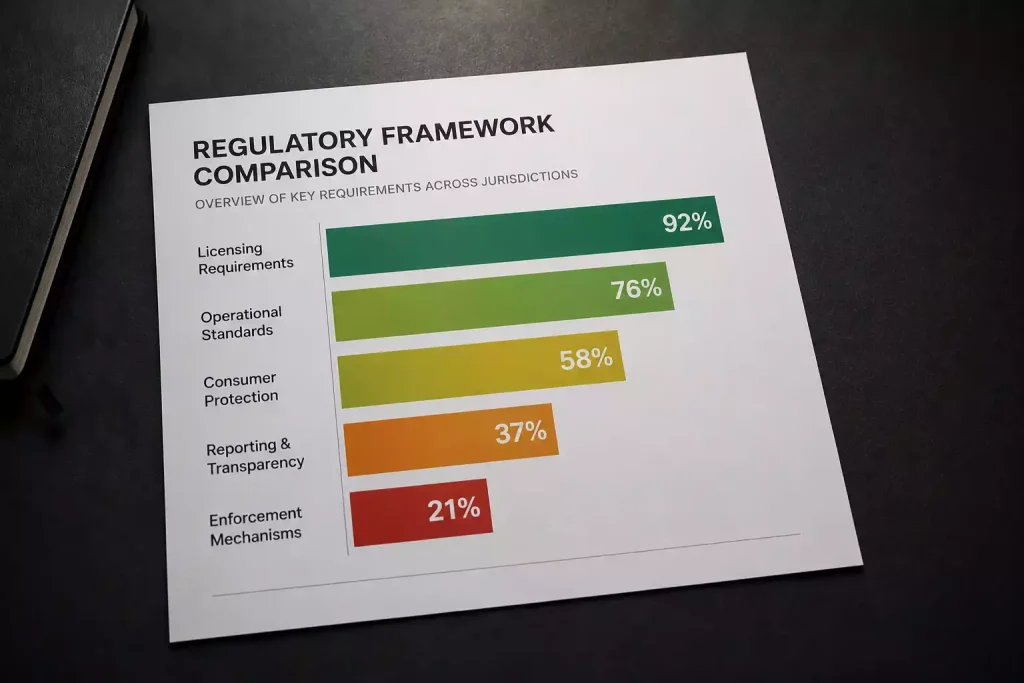
At offshore brands the regulatory pressure is different but the economic outcome is similar: a no-deposit offer in a market saturated with bonus-hunters yields a small base of high-value converted depositors. Operators have learned to set the headline higher and the terms tighter rather than abandon the format entirely. When you see a no-deposit offer advertised at an offshore casino, the chance that it carries terms a UKGC operator could not legally publish — 35×, 40× or 50× wagering, maximum cash-out capped at five to twenty times the bonus, narrow eligible-game lists — is the working assumption.
The x10 Wagering Cap and Why It Reshapes No-Deposit Maths at UK Operators
The wagering requirement is the multiplier the player must stake before bonus winnings can be withdrawn. A £10 credit with a 35× wagering requirement requires £350 of staked play; the same credit under the UK’s 10× cap requires £100. The difference compounds: under 35×, you turn over your bonus value 35 times, exposing it 35 times to the house edge. At a 4% house edge on a typical online slot, that is mathematically a near-certain erosion of the credit.
The cap was introduced as part of the Gambling Commission’s response to the 2023 White Paper on gambling reform. It applies to all UKGC-licensed operators and to bonuses on Great Britain–facing licences. It does not apply to operators outside the UKGC’s licensing perimeter. That distinction is the central point of any offshore-vs-UK bonus comparison: the same nominal bonus structure can be presented under wildly different real terms depending on who licenses the operator.
For players, the practical implication is that a no-deposit offer at an offshore brand needs to be read in detail before it can be compared with a UK offer. The UK x10 cap, combined with the rules around maximum stake size during wagering and game-weighting transparency, has made the UKGC no-deposit a relatively well-defined product. Offshore offers, including those at Love Casino’s wider bonus framework, are not.
What Verification Looks Like Before You Claim Any Listed No-Deposit Offer
Before claiming a no-deposit credit at any offshore casino, the following six items in the cashier T&Cs typically determine whether the offer is workable:
- Wagering multiplier and base. Confirm whether the multiplier applies to the bonus alone (bonus-only) or to bonus + winnings (D+B). The latter inflates the effective requirement substantially.
- Maximum cash-out. Some offshore offers cap converted winnings at as little as five times the credit. A £10 credit with a £50 cash-out cap is structurally not a £10 prize.
- Maximum stake during wagering. A common breach point. Stakes above the listed maximum (often £4–£6, sometimes lower) void the bonus and any winnings, regardless of whether the breach was inadvertent.
- Game weighting. Most slots contribute 100% to wagering, but blackjack, roulette, video poker and table games typically contribute 10% or less. The implicit redirection toward high-variance slots is the operator’s hedge.
- Time window. No-deposit credits often carry 24-hour, 72-hour or 7-day completion windows. Outside the window, winnings are forfeit.
- Country and account restrictions. No-deposit offers commonly exclude high-bonus-hunter markets and any account showing the same IP, device or payment method as an existing account.
A no-deposit offer that publishes these six items clearly is rare. One that does not is the same offer with the same terms, written down somewhere the operator does not need to honour publicly.
How No-Deposit Value Translates to Real Money: A Worked Example
Consider a £10 no-deposit credit with 40× wagering on bonus only, £500 maximum cash-out, 100% slot contribution, £4 maximum stake, a 7-day window. The wagering obligation is £400 of staked play. On a representative online slot with a 96% return-to-player rate, the expected value of £400 of play is £384 returned to the player. The expected balance after wagering is £10 (initial credit) minus £16 (expected losses to the house edge) — already negative before any positive variance.
What rescues the expected value into positive territory is the variance. The credit is an option: most outcomes are losing, but the tail is occasionally a meaningful win. The £500 cash-out cap then truncates that tail. The mathematical expectation, integrated across the variance distribution, depends on the volatility of the chosen slot and how the wagering completes, but it is typically in the range of £1 to £3 of expected value on a £10 credit — about 10% to 30% of face value.

That is not a complaint against the format. It is the structural reality of bonuses generally: they are not gifts, they are conditional access to a product, and their value is the option premium an attentive player can extract from them under the listed terms. The point of the calculation is that “£10 no-deposit bonus” is a marketing label, not a money equivalent.
For deeper coverage of how wagering requirements work and what the headline figures hide, see the analysis at wagering requirements at Love Casino and the broader breakdown of bonus terms players miss.
Does Love Casino offer a no-deposit bonus right now?
Public availability cannot be independently verified at any single point in time — promotional pages at offshore brands change without notice and are not subject to the disclosure requirements UKGC operators face. Treat any listed no-deposit offer as a claim to verify on the cashier page at the moment of sign-up, not as a stable fact.
Why are no-deposit bonuses rarer than they were five years ago?
Two converging pressures — tighter wagering-cap rules at UK-licensed operators since 17 January 2025 and the operator-side cost of a no-deposit offer in a £5-stake-limit environment — have shifted promotional spend toward deposit-match welcomes and free-spin packages on first deposit. At offshore brands, the trend follows.
If I do see a no-deposit offer advertised, what should I check first?
The wagering multiplier, the maximum cash-out, the game-weighting list (especially blackjack and roulette contribution), the maximum stake while wagering, the time window for completing wagering, and whether the offer is restricted to specific countries or new accounts only. Each of these has voided more no-deposit winnings than the bonus itself ever paid out.
Is a no-deposit bonus ever genuinely ‘free money’?
Mathematically, the expected value is rarely zero, but it is almost always well below the face value of the bonus. A £10 no-deposit credit with a 40× wagering requirement and £500 maximum cash-out is not £10 of value — it is an option whose expected value depends entirely on how the wagering, max-bet and cash-out clauses interact.
Does the UK x10 wagering cap apply to offshore casinos?
No. The x10 cap, set out in the Gambling Commission’s Licence Conditions and Codes of Practice change effective 17 January 2025, applies only to operators holding a UKGC licence. Offshore-licensed casinos like Love Casino are outside its jurisdiction and continue to advertise 35×–50× wagering on bonuses.